Some people have never been “fortunate” enough to meet them and others have been saved by them, yet when that crash comes your way you'll pray to the deities it pops. If you've haven't realized it by now, we're talking about the “airbag”.
Nowadays they're present in every car out there, every car that doesn't date back to the ice age that is. We thought we'd walk you today through the fast stages of the airbag activation, inflation and deflation. But first, a bit of history and other tidbits.
History of the airbag
The first steps towards today's airbag were taken by John W. Hetrick, a retired industrial engineering technician, in the early '50s. Following a car accident involving Mr. Hetrick and his wife and daughter, he thought of a device that would prevent passengers from hitting the inside of a car.
He received a patent in 1953 for something called "safety cushion assembly for automotive vehicles." At about the same time, German inventor Walter Linderer received a patent for a similar prototype. Mr. Linderer's product was using a compressed air system, which could be either released by bumper contact or by the driver.
Following the two patents, Ford and General Motors started tinkering with inflatable restraints, but they were faced with two big problems. One of them was related to the detection of a collision and the inflation of the airbag, which took too long to work properly. The second issue was that the airbags themselves would cause secondary injuries to passengers.
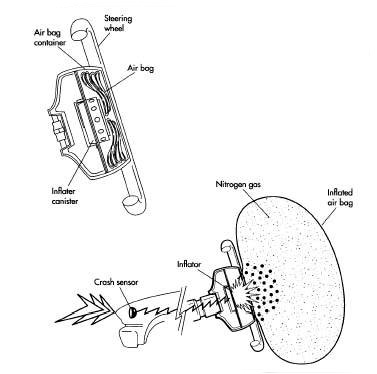 It wasn't until the late 1960's that the airbag development made some real progress. The man responsible for this? A New Jersey mechanical engineer by the name of Allen K. Breed. He invented what is considered the world's first electromechanical automotive airbag system in the form of a crash sensor.
Mr. Breed would later on come up with another important development in the field, namely the airbag that vents air as it inflates, reducing the risk of secondary injuries by reducing the inflated bag's rigidity.
Soon after that, Ford built an experimental airbag fleet (1971), while General Motors tested airbags on a 1973 model Chevrolet, albeit only sold for government use. The year 1973 brought the first passenger car fitted with an airbag for the general public, this breakthrough arriving as a 1973 Oldsmobile Toronado. One year later, Buick, Cadillac and Oldsmobile offered dual airbags as an option on several of their full-sized models. Mercedes-Benz was the first to offer the modern airbag as an option on their S-Klasse model.
The big difference between the US and German approach was that while Ford and GM marketed their airbags as an alternative to the seatbelt, Mercedes-Benz combined the two safety devices for more efficiency in preventing in injuries.
The first side and torso airbags became optional in 1995 on Volvo's 850 models. Three year later, the US federal government mandated dual frontal airbags on all passenger vehicles. The first airbag system for motorcycles came from Honda in 2006.
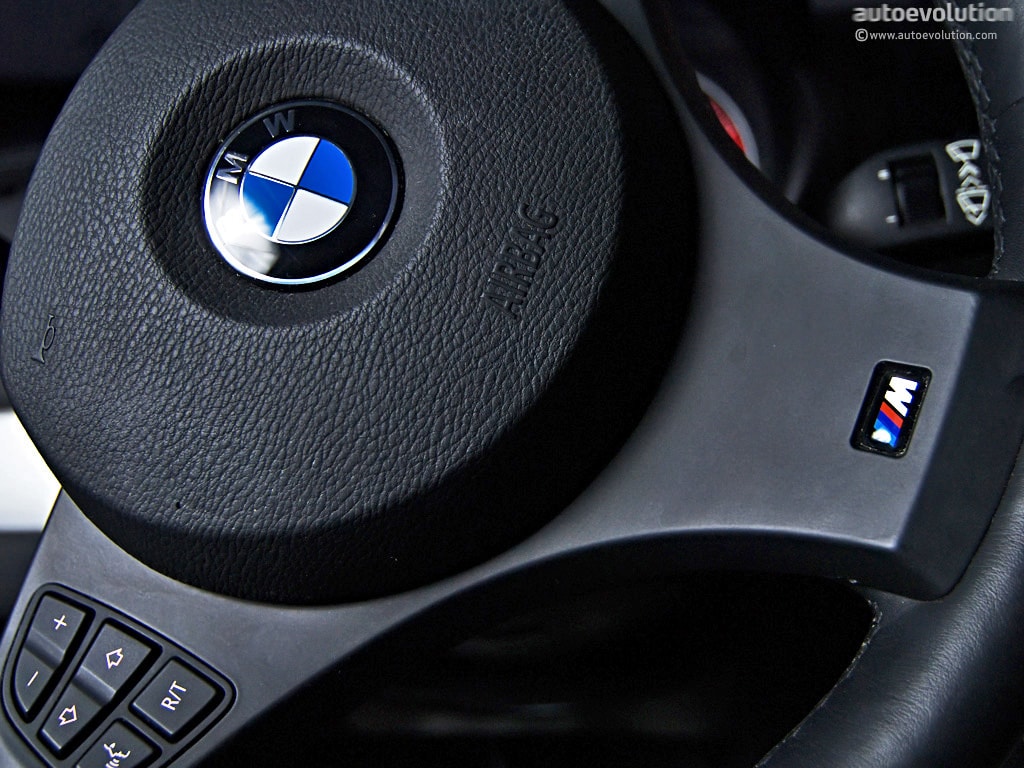 The most common type of airbag is the frontal one, which inflates in a fraction of a second to prevent occupants from striking the interior of the vehicle during a moderate to severe crash. In lower-speed frontal crashes, an advanced airbag system provides the appropriate level of protection by inflating a frontal airbag with less force or by shutting off a frontal airbag entirely.
The second most popular type is the side airbag (SAB), which is obviously activated in side impacts. This one provides protection against head and/or torso injuries. There are three main types of SABs: chest side airbag, head side airbag and a combination of both. NHTSA estimates that in side-impact crashes involving at least one fatality, nearly 60 percent of those killed have suffered brain injuries. It is also estimated that if all U.S. vehicles were equipped with head protection SABs - as compared to no vehicles being equipped with this technology - a total of 976 lives would be saved and another 932 serious injuries prevented each year.
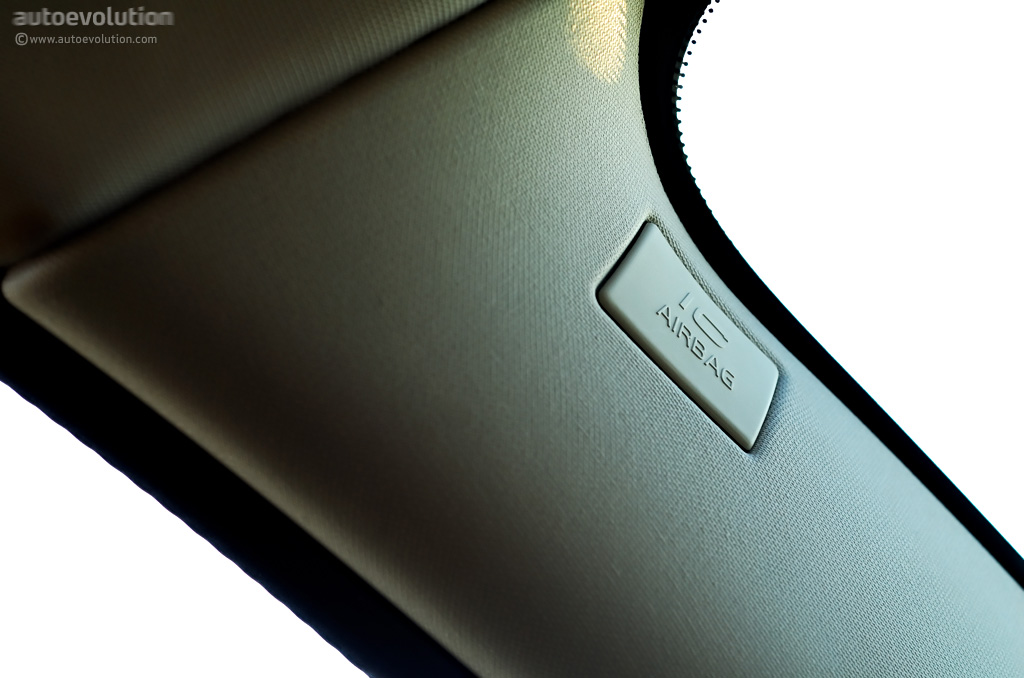 More recent innovations include the knee airbag, brought in 2003 by the Mercedes-Benz SLR McLaren, the rear curtain airbag, introduced by the Toyota iQ in 2008 and the rear center airbag, developed by the same Toyota in 2009 to protect rear passengers in case of side collisions.
All these sensors are in intimate connection with the ACU (Airbag Control Unit), the very brain of the airbag system. The unit decides if and how to deploy the airbags. When the ACU detects that the deployment threshold has been reached, it initiates the inflation stage.
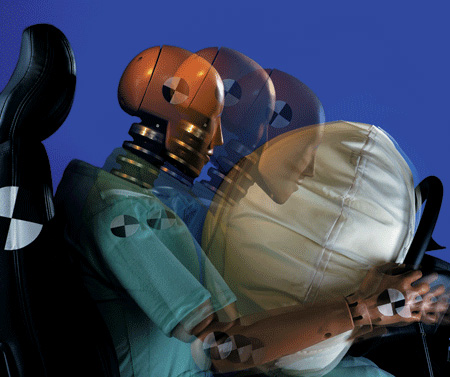 As the compressed air system would have been impractical and quite inefficient, engineers came up with an idea quite similar to the working principle of the solid rocket booster. Each airbag incorporates a pyrotechnic device, known as an initiator or electric match, consisting of an electrical conductor cocooned in combustible material. A current pulse heats up the conductor, which in turn ignites the combustible material. This igniter triggers the chemical reaction that actually fills the nylon fabric airbag with gas.
The large volume of gas then forces the airbag out of the steering wheel and/or dashboard at a speed of up to 200 mph or 322 kph, the whole process taking about 0.04 seconds. Considering that the blink of an eye is approximated at 0.2 seconds, one could say it's quite a speedy process.
The last stage of the airbag process is the deflation, which occurs almost immediately after the inflation is completed. The gas escapes through special vents, which also prevent the occupants from suffering major impact injuries. Another effect of the deflation is the release of dust-like particles, mostly cornstarch and talcum powder, that are used to lubricate the airbag.
Initially, the chemicals used in airbags were a major health concern, but present systems will only produce a mild irritation of the throat and eyes.
He received a patent in 1953 for something called "safety cushion assembly for automotive vehicles." At about the same time, German inventor Walter Linderer received a patent for a similar prototype. Mr. Linderer's product was using a compressed air system, which could be either released by bumper contact or by the driver.
Following the two patents, Ford and General Motors started tinkering with inflatable restraints, but they were faced with two big problems. One of them was related to the detection of a collision and the inflation of the airbag, which took too long to work properly. The second issue was that the airbags themselves would cause secondary injuries to passengers.
Mr. Breed would later on come up with another important development in the field, namely the airbag that vents air as it inflates, reducing the risk of secondary injuries by reducing the inflated bag's rigidity.
Soon after that, Ford built an experimental airbag fleet (1971), while General Motors tested airbags on a 1973 model Chevrolet, albeit only sold for government use. The year 1973 brought the first passenger car fitted with an airbag for the general public, this breakthrough arriving as a 1973 Oldsmobile Toronado. One year later, Buick, Cadillac and Oldsmobile offered dual airbags as an option on several of their full-sized models. Mercedes-Benz was the first to offer the modern airbag as an option on their S-Klasse model.
The big difference between the US and German approach was that while Ford and GM marketed their airbags as an alternative to the seatbelt, Mercedes-Benz combined the two safety devices for more efficiency in preventing in injuries.
The first side and torso airbags became optional in 1995 on Volvo's 850 models. Three year later, the US federal government mandated dual frontal airbags on all passenger vehicles. The first airbag system for motorcycles came from Honda in 2006.
Types of airbag
The second most popular type is the side airbag (SAB), which is obviously activated in side impacts. This one provides protection against head and/or torso injuries. There are three main types of SABs: chest side airbag, head side airbag and a combination of both. NHTSA estimates that in side-impact crashes involving at least one fatality, nearly 60 percent of those killed have suffered brain injuries. It is also estimated that if all U.S. vehicles were equipped with head protection SABs - as compared to no vehicles being equipped with this technology - a total of 976 lives would be saved and another 932 serious injuries prevented each year.
How it works
The first stage of the airbag deployment is the accident itself. The collision, be it frontal or lateral, activates an array of sensors in the vehicle, including accelerometers, impact sensors, side pressure sensors, brake pressure sensors, gyroscopes and seat occupancy sensors.All these sensors are in intimate connection with the ACU (Airbag Control Unit), the very brain of the airbag system. The unit decides if and how to deploy the airbags. When the ACU detects that the deployment threshold has been reached, it initiates the inflation stage.
The large volume of gas then forces the airbag out of the steering wheel and/or dashboard at a speed of up to 200 mph or 322 kph, the whole process taking about 0.04 seconds. Considering that the blink of an eye is approximated at 0.2 seconds, one could say it's quite a speedy process.
The last stage of the airbag process is the deflation, which occurs almost immediately after the inflation is completed. The gas escapes through special vents, which also prevent the occupants from suffering major impact injuries. Another effect of the deflation is the release of dust-like particles, mostly cornstarch and talcum powder, that are used to lubricate the airbag.
Initially, the chemicals used in airbags were a major health concern, but present systems will only produce a mild irritation of the throat and eyes.
 Google News