
Slow, big, incapable to perform burnouts and very often a dreaded sight for Prius owners...If you are an American, or at least a NASCAR fan, you would know what a team hauler is. If you are neither, you have two choices: you either go and turn the Earth upside down to find a copy of "Days of Thunder," or you let us tell you a little bit about them.
Unlike the trucks used to transport Formula 1 cars in Europe, NASCAR team haulers (the name given to the trucks used to transport the cars from one track to another) are much more visible. And, for those of you who know a bit about the phenomena, the haulers are a spectacle of their own.
When it comes to NASCAR haulers, however, the transportation of the racing cars is just one side of the their job. Capable of carrying even two cars (there are some designed to accommodate even four cars), the haulers are modified into becoming more than just a means of transport, but a repair shop and parts warehouse as well.
Apart from the cars, haulers need to carry pit equipment, supplies, tools and even engines and transmissions (not to mention the crew itself). Once at the track, the haulers do a bit of a 'Transformers act' and become the teams' headquarters, repair shop and conference room.
Why haulers?
All the hauler-frenzy began sometime in the mid-1960s, when it became obvious the only way to win a NASCAR race was to own a rear-engined car. This fact in itself didn't present much problems, but these types of cars required more parts and more dedicated tools to repair them. This, in itself, was not the problem either, as the money poured into the sports gave team mechanics access to just about any part they dreamed of.
There are two main reasons behind the advent of the NASCAR team haulers. The first was the fact that racetracks across the US lacked any proper pits for refitting, refueling and repairing the cars. The increasing value and volume of additional equipment, as well as the increasing value of the race car itself brought on the second reason: cars, parts, equipment and teams needed to be transported safely from track to track.
The double-decker haulers we see today were thus born out of necessity, and as a result of several people bettering one idea. At first, the more and more sophisticated race cars and the increasing volume of spare parts and tools were being moved on drop-bed trailers. The trailer soon began getting modified and the race cars were slowly moved up into the trailer, above its middle line. In time, the trailers received the second deck, under the compartment housing the cars.
Haulers of today
Choosing a hauler is, perhaps, as important for the teams as choosing the race car itself. The stars of NASCAR nights need to be transported safely from race-track to race-track, as does the team itself. Of course, the tractor head of the hauler can be of any make and model, whether it is a Mack, a Freightliner or whatever. What matters is the trailer itself, the garage, command center and kitchen of every NASCAR team.
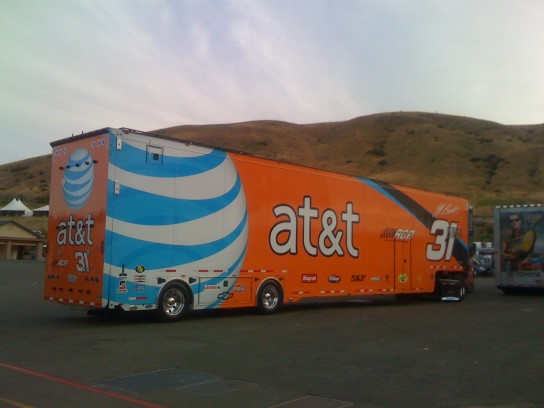
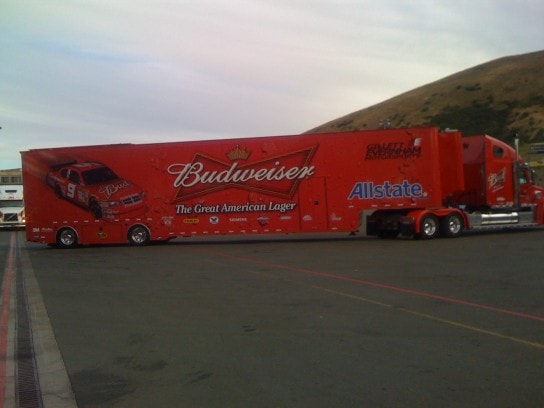
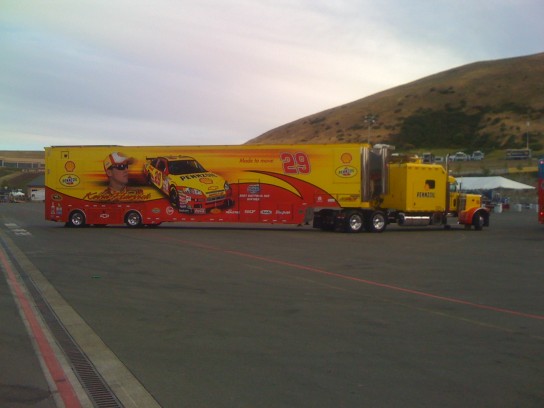
The modern day hauler is comprised of three distinct areas, namely an upper level (or deck), where the race cars are housed, a lower level and the so called lounge.
The first of the three compartments, besides holding the cars, is the main storage area for toe bars, ladders and fuel cans, and anything track-related. The tailgate of the haulers can be lowered and transformed into a lift, allowing for the easy loading/unloading of the cars. The upper level is also used to store additional equipment, ladders, gas cans, and so on.
The lower level, which can be accessed through the now infamous mirror doors, is divided into several sections. Each of the NASCAR teams modify their lower level to suit their own needs, but there are several common sections. First, there's the section where mechanics use to store tools. Second, the section where spare parts are housed: transmissions, suspensions, nuts and bolts, and even engines.
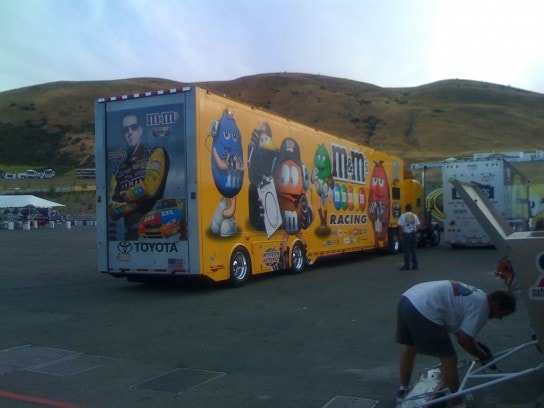
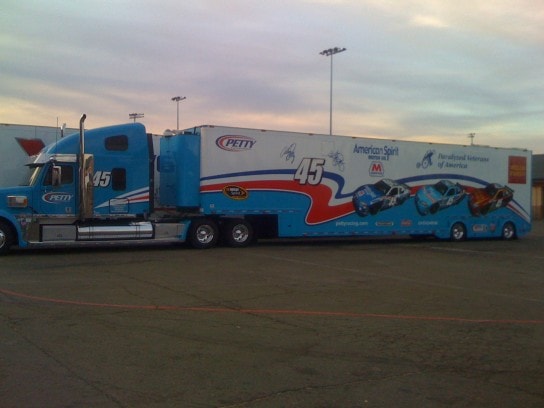
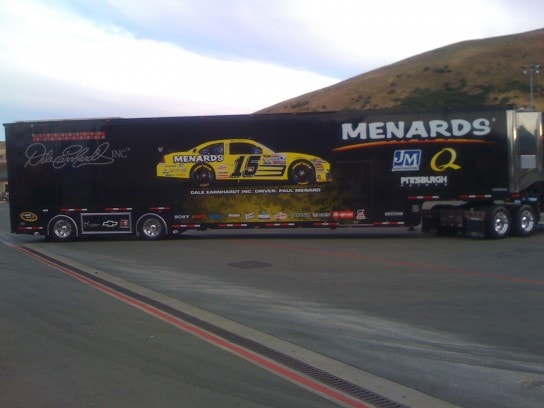
The most eye-catching section of the hauler is the lounge, which contains just about everything you need to take a bit of time off. As more and more teams use more than one hauler to move from race to race, the lounges are now split, depending on the truck they are on, and they serve the drivers, the engineers or even sponsors.
A hauler is fitted with everything needed for team members as they travel from track to track: couches, refrigerators, TVs and so on. Once at the track, the hauler is converted into a command center, with live timings, mechanics and tires spread all-round.
At the track
NASCAR has both written and unwritten rules which apply not only to race cars and race drivers, but haulers and hauler drivers as well. When at a race track, haulers are lined up according to their points standings before the respective race. The distance between them is of 5 feet.
When camped for a race, a team hauler is surrounded by staff and equipment. After the cars are unloaded the team prepares for the race by literally surrounding the hauler with spare tires, spare parts, and chairs.
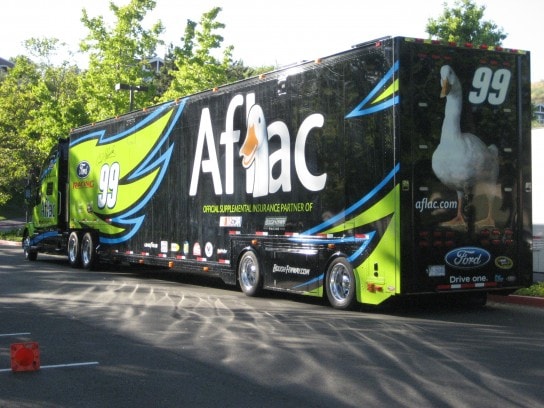
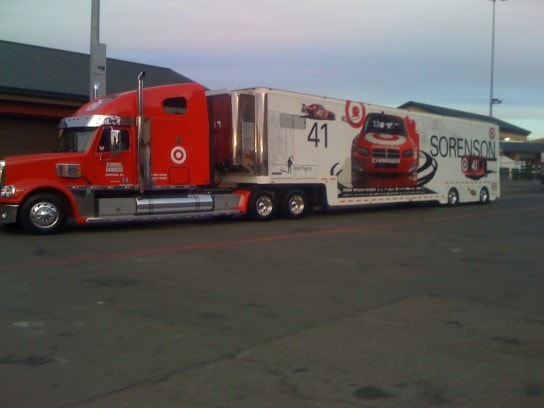
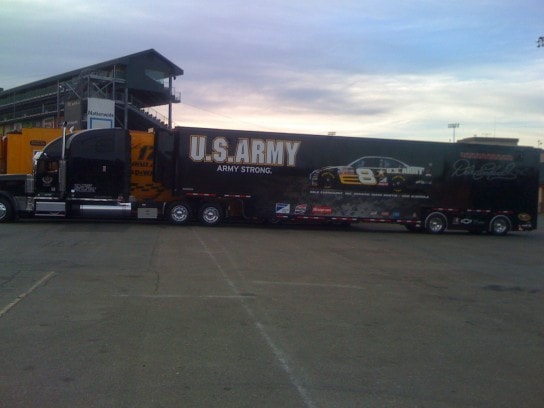
NASCAR team haulers however, mean an entirely different thing for the public. Often in the backstage, team haulers only take the spotlight when on the road. Only recently, NASCAR hauler drivers found that if they drive down Las Vegas Strip, a big crowd would come and watch the 50 team hauler parade.
A very delightful moment to witnes is represented not only by the truck itself, but by the paintings on it. These huge, 'self propelled adds' are painted all over with the team's name, sponsor's name and logos...As each and every one of them is different from the other, seeing some 50 of them on the same street is a sight for sore eyes. As you can see for yourselves in the video below...
Additional images can be found here.
The modern day hauler is comprised of three distinct areas, namely an upper level (or deck), where the race cars are housed, a lower level and the so called lounge.
The first of the three compartments, besides holding the cars, is the main storage area for toe bars, ladders and fuel cans, and anything track-related. The tailgate of the haulers can be lowered and transformed into a lift, allowing for the easy loading/unloading of the cars. The upper level is also used to store additional equipment, ladders, gas cans, and so on.
The lower level, which can be accessed through the now infamous mirror doors, is divided into several sections. Each of the NASCAR teams modify their lower level to suit their own needs, but there are several common sections. First, there's the section where mechanics use to store tools. Second, the section where spare parts are housed: transmissions, suspensions, nuts and bolts, and even engines.
The most eye-catching section of the hauler is the lounge, which contains just about everything you need to take a bit of time off. As more and more teams use more than one hauler to move from race to race, the lounges are now split, depending on the truck they are on, and they serve the drivers, the engineers or even sponsors.
A hauler is fitted with everything needed for team members as they travel from track to track: couches, refrigerators, TVs and so on. Once at the track, the hauler is converted into a command center, with live timings, mechanics and tires spread all-round.
At the track
NASCAR has both written and unwritten rules which apply not only to race cars and race drivers, but haulers and hauler drivers as well. When at a race track, haulers are lined up according to their points standings before the respective race. The distance between them is of 5 feet.
When camped for a race, a team hauler is surrounded by staff and equipment. After the cars are unloaded the team prepares for the race by literally surrounding the hauler with spare tires, spare parts, and chairs.
NASCAR team haulers however, mean an entirely different thing for the public. Often in the backstage, team haulers only take the spotlight when on the road. Only recently, NASCAR hauler drivers found that if they drive down Las Vegas Strip, a big crowd would come and watch the 50 team hauler parade.
A very delightful moment to witnes is represented not only by the truck itself, but by the paintings on it. These huge, 'self propelled adds' are painted all over with the team's name, sponsor's name and logos...As each and every one of them is different from the other, seeing some 50 of them on the same street is a sight for sore eyes. As you can see for yourselves in the video below...
Additional images can be found here.
 Google News