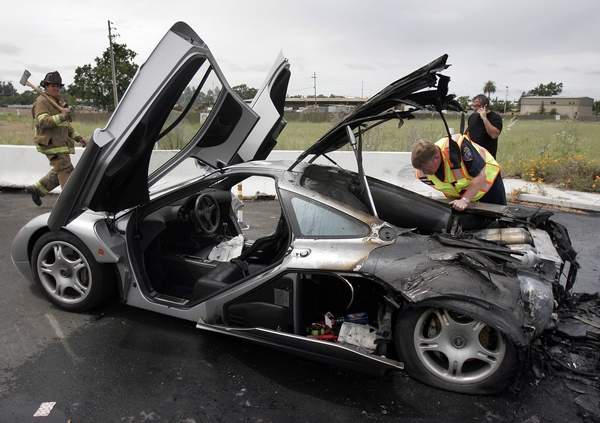
As Irv Kessler, 53, drove his $2 million rare Mclaren F1 on the boulevard, someone noticed smoke coming from the back of the car and alerted him. But by the time he exited the car to check the problem, the car was engulfed by flames.
Though its owner was a Minnesota resident, the car had Oregon license plates. The Rincon Valley firefighters found the car still burning but doused it before it spread to the passenger compartment. Luckily, the car was insured for $3 million, as Kessler told the firefighters.
“It hadn’t been driven in six months,” said John Lantz, Rincon Valley assistant fire chief for The Press Democrat. “They took it out yesterday and today and started having some kind of problem with it,” Lantz said he was told by Kessler.
According to McLaren’s website, the car was built as ”the world’s first production road car to feature an all carbon composite monocoque and body structure,” using Formula One racing technology on the road.
The F1 was powered by a BMW S70/2 engine, specifically designed and built for the car. The 6.1-litre, quad-cam, 48-valve V12 powerplant produced 627 horsepower, driving through a six-speed transaxle gearbox. This engine powered McLaren to victory at Le Mans on its debut in 1995 and to several FIA GT championships.
The car also featured a central driving position for optimum visibility, dihedral doors for easy ingress and egress, active aerodynamics and 'ground-plane shear' suspension geometry for the vehicle’s dynamics.
 Google News