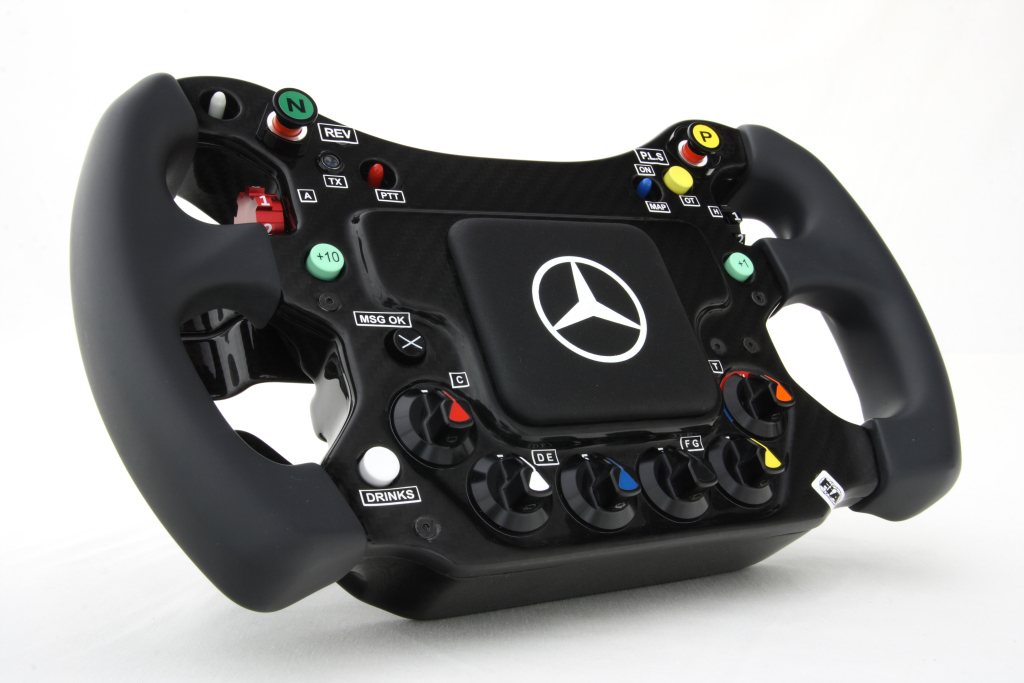
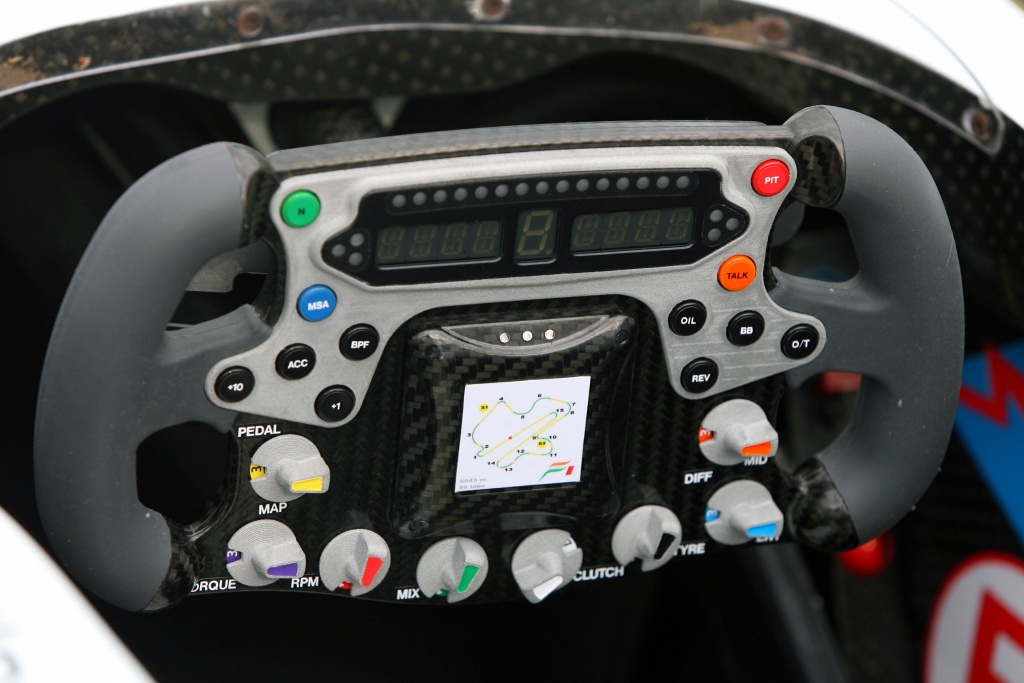
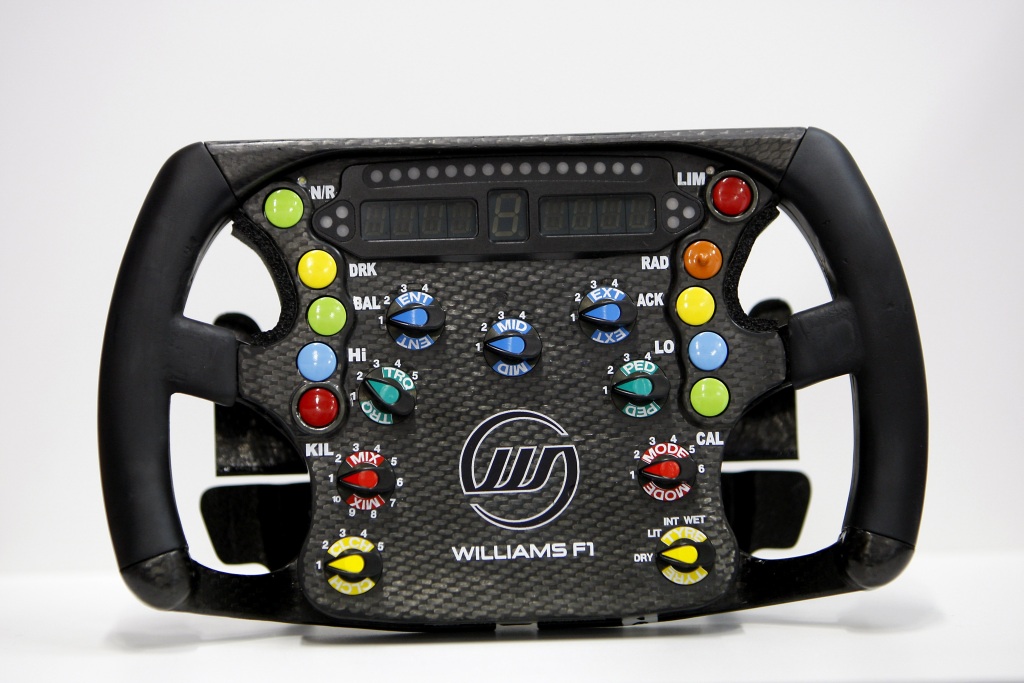
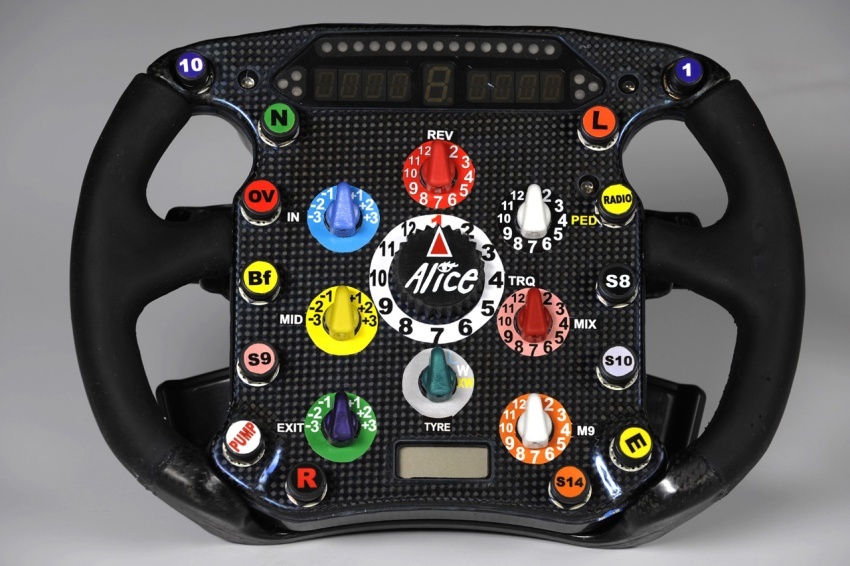
For starters, let's proceed to a quick overview. Consider the fact that, during a grand prix race, a driver has to: change gears for approximately 3,500 times, keep radio contact with the team, check fuel level, deploy KERS (recently added), activate drink pump, select tire adaptation, preset the wing depending on the race conditions, watch the display giving him useful information on revs, lap times, speed, gear (etc), change brake settings, activate pit lane limiter (when needed), control differential settings, and so on.
These are, of course, only a few things a driver should take into consideration when stepping into an F1 cockpit. Given the aforementioned enumeration, we feel like we've given you enough reasons to consider the difficulty of driving an F1 car during the one hour and a half of grand prix racing. Needless to say, the only component of an F1 car that a driver can use to take care of all those settings is the steering wheel.
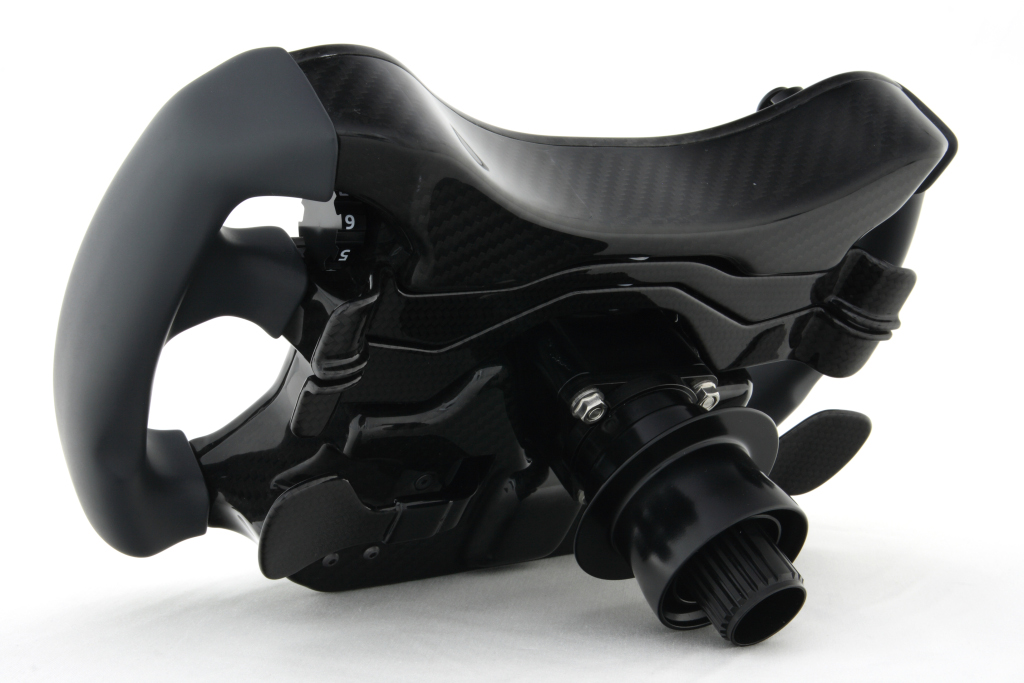
Also, according to the current FIA regulations, due to safety reasons, the nowadays steering wheels in Formula One are fitted with easy-to-release mechanism in order for the drivers to quickly remove it from the cockpit in case of accidents. As you've probably witnessed plenty of times during the broadcasting of an F1 race, a driver would always take his steering wheel out of the car first, and then get out of the cockpit. This is because the driver doesn't have enough space to extract himself from the car, unless releasing the steering wheel first.
Secondly, each steering wheel is constructed differently – when considering the distribution of the buttons and rotary switches – depending on the driver. Even within the same team, the steering wheel usually looks different from driver to driver (even test drivers use customized steering wheels, for improved handling), as each has a particular way of distributing his attention on the entire surface of the unit.
Let's take the BMW Sauber case for example, with the following steering wheel configurations belonging to race drivers Nick Heidfeld and Robert Kubica for 2009:
In Robert Kubica's case, here are what those 28 triggering devices do:
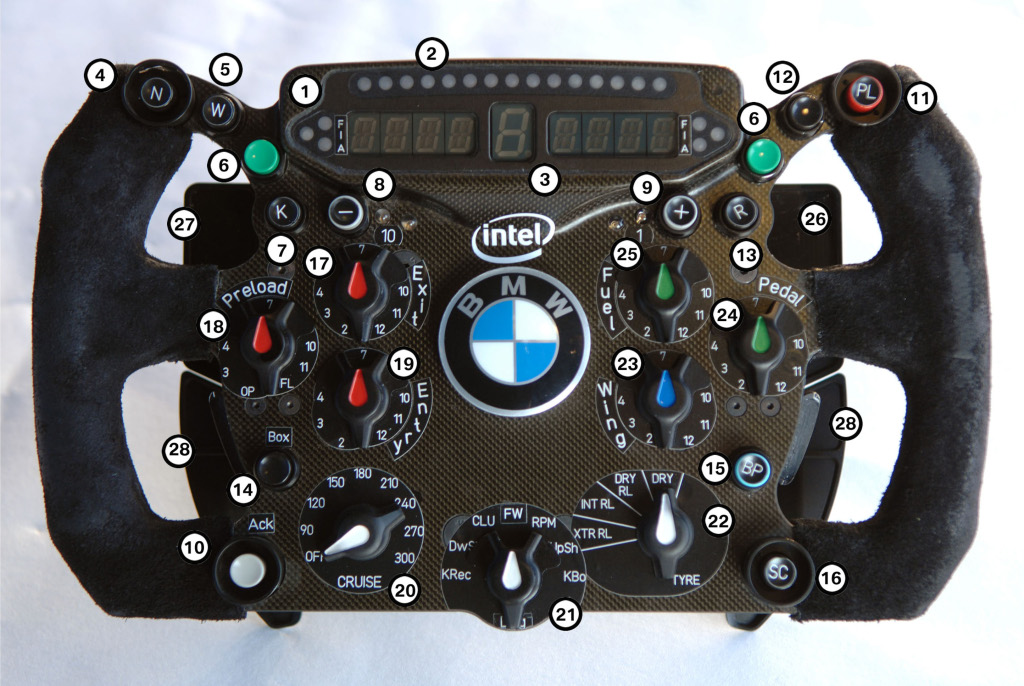
1. Info of FIA/Race Control
2. Shift lights
3. Multi purpose display (engine revs, lap times, speed, gear, etc)
4. Neutral (usually when at the pit stop)
5. W – activate front wing
6. Multi purpose button
7. K – KERS boost button
8. – (presetting down)
9. + (presetting up)
10. Ack – Acknowledge
11. PL – Pit lane limiter
12. spare
13. R – radio
14. Box – pit stop
15. BP – Clutch
16. SC – Safety Car
17. Differential
18. Preload Differential Settings
19. Differential
20. Cruise Control
21. Selector (KERS, Front Wing, RPM)
22. Tire adaptation
23. Presetting front wing
24. Pedal map
25. Fuel mix
26. Upshift paddle
27. Downshift paddle
28. Clutch
In Nick Heidfeld's case, nothing changes much really, except for some different button allocations.
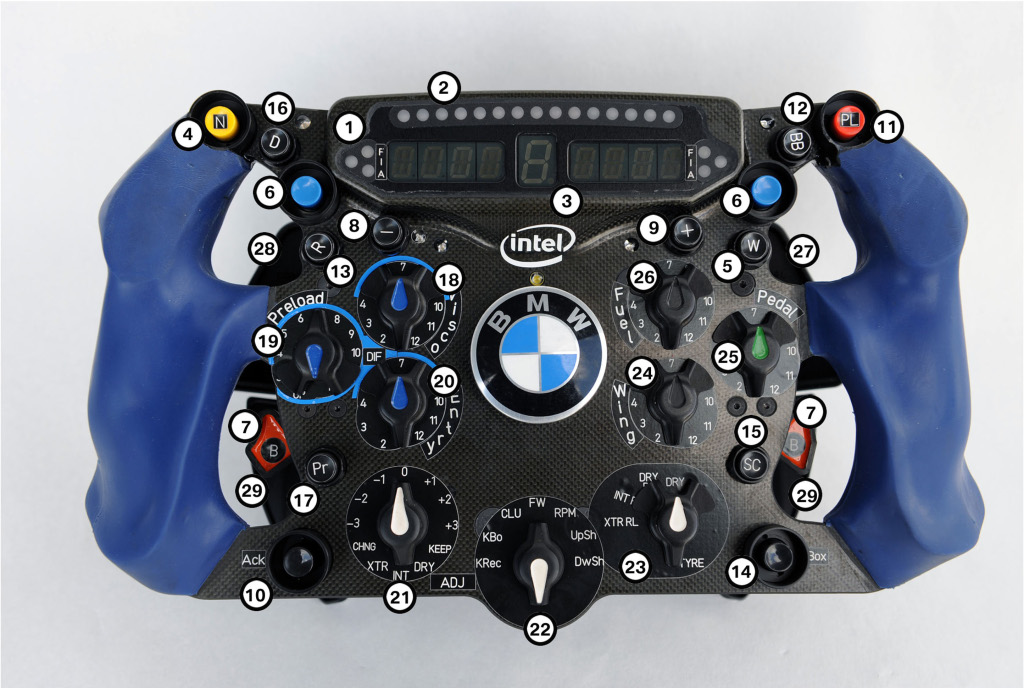
1. Info of FIA/Race Control
2. Shift lights
3. Multi purpose display (engine revs, lap times, speed, gear, etc)
4. Neutral (usually when at the pit stop)
5. W – Activate front wing
6. Multipurpose button
7. K – KERS Boost button
8. – (presetting down)
9. + (presetting up)
10. Ack – Acknowledge
11. PL – Pit lane limiter
12. BB – Brake Balance
13. R – Radio
14. Box – Pit Box
15. SC – Safety Car
16. D – Drink
17. Pr – Problem Marker Button
18. Differential
19. Preload – Differential settings
20. Differential
21. Info to Pitcrew
22. Selector (KERS, front wing, RPM)
23. Tire adaptation
24. Wing – Presetting front wing
25. Pedal Map
26. Fuel Mix
27. Upshift Paddle
28. Downshift Paddle
29. Clutch
 Google News